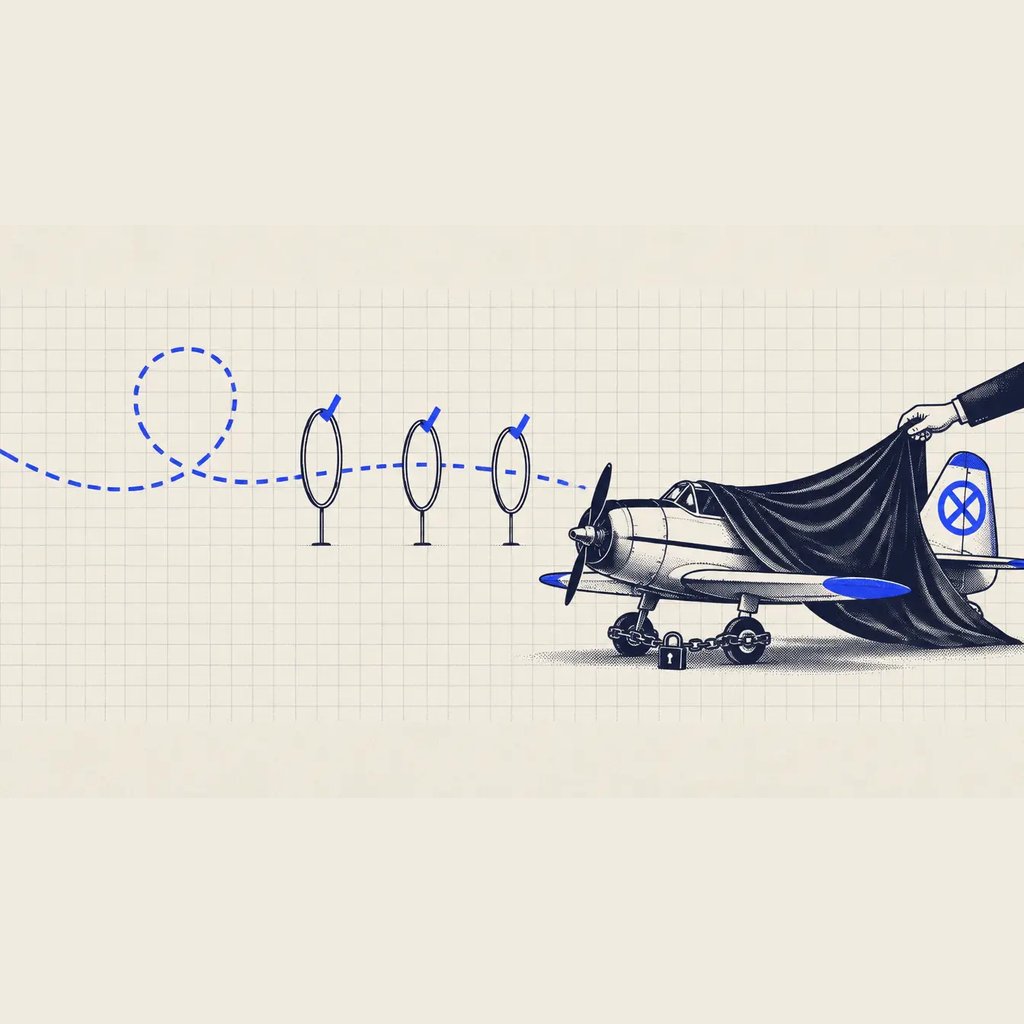
Everyone quotes the same forecast: more than 40% of agentic AI projects cancelled by 2027, blamed on escalating costs, unclear business value and weak risk controls. It lands in board decks as evidence that the technology isn't ready.
That's not what I see.
Most of the AI pilots I've watched get killed didn't miss their numbers. They hit them. The agent handled the volume it was scoped for. The resolution rate was there. The report went to the steering group and everyone agreed it worked.
Then nothing happened. No scale-up budget, no second phase, no owner. Twelve months later the same company is scoping another proof of concept with a newer model, on the assumption that the last one wasn't good enough.
It was good enough. It just never got out of the pilot.
Four ways a working AI pilot dies
1. It proved a capability nobody owned
Scoped by innovation or IT, with the savings landing in someone else's P&L. The team that ran it had no budget to scale it. The team with the budget had no reason to care. This is the single most common way an AI agent deployment stalls between proof of concept and production, and it is an org chart problem, not a technical one.
2. Success was measured in the wrong language
Containment rate, deflection rate and average handle time are the right operational metrics and the wrong boardroom ones. Nobody translated them into capacity released, headcount avoided or cost per resolved outcome, so the project finished with a result but no argument. When budget season arrived, there was nothing to defend.
3. Nobody costed year two
The pilot was cheap because it was small. Median enterprise spend on large language models grew more than sevenfold year on year, and inference costs scale with volume in a way pilot budgets never model. Plenty of AI automation projects died the moment someone finally ran that number at full production volume.
4. It ran on pilot architecture
Built to prove a point in six weeks, not to run for three years. No evaluation loop, no fallback path, no observability, no rollback. Scaling meant rebuilding, the business heard "start again," and confidence quietly drained away.
These are operating model failures, not model failures
Every one of them happens after the technical work succeeded. That distinction is the whole story of enterprise AI right now: adoption is effectively saturated, while the share of companies reporting real financial impact stays stubbornly small.
If you think pilots fail because the tech isn't ready, you wait a year and run another one. You get the same result, because the model was never the constraint.
The research backs the uncomfortable version. The organisations actually getting returns from AI are not the ones with privileged access to better models. Everyone is buying from the same handful of labs. They are the ones who redesigned the underlying process rather than layering an agent on top of it, and who decided who owned the outcome before anyone wrote a prompt.
What to fix before the next pilot
Name the owner before the use case
Not the executive sponsor. The person whose P&L improves if this works, who controls the budget to widen it, and who will still be in the job in eighteen months. More than half of enterprises now name a dedicated AI agent owner or agentic ops lead, up from roughly one in ten two years ago, and that ownership tracks closely with who reaches production at all.
Agree the business metric on day one
In writing, next to the technical one. Decide now what number, moving in what direction, means this gets scaled. A containment rate on its own is a finding, not a case for budget.
Model the cost at full volume first
Run the unit economics at ten times pilot traffic before you build at one times. If it doesn't work at scale on paper, you're running a research exercise rather than a deployment. That's a legitimate thing to do, but say so upfront, and don't let anyone expect a rollout at the end of it.
Build the governance in, not on
Approval gates, audit trail, fallback and rollback from week one. Guardrails get framed as a brake on velocity; in practice they're the reason a deployment is ever trusted enough to widen. Agent tooling has shifted hard from suggesting to acting, from drafting the email to sending it, from flagging the payment to moving it, and controls have not kept pace.
Decide what happens if it succeeds
Who signs off, from which budget, on what timeline. If nobody can answer that in week one, the answer in month six is nobody.
The comfortable answer is to wait. It's also wrong.
There is a version of this conversation that blames the models, and it is comfortable because it means the answer is to wait. Wait for the next release, the next context window, the next price cut. Meanwhile the median payback on agent deployments that do reach production sits at around five months, and the companies hitting it are not technically exceptional. They are organisationally clear.
The harder version: if your AI pilot died, the post-mortem probably belongs with the operating model, not the technology. Nobody wants to run that review, because it doesn't end with a vendor to swap out.
If you've had a pilot that worked and still didn't scale, what stopped it? Comment below.