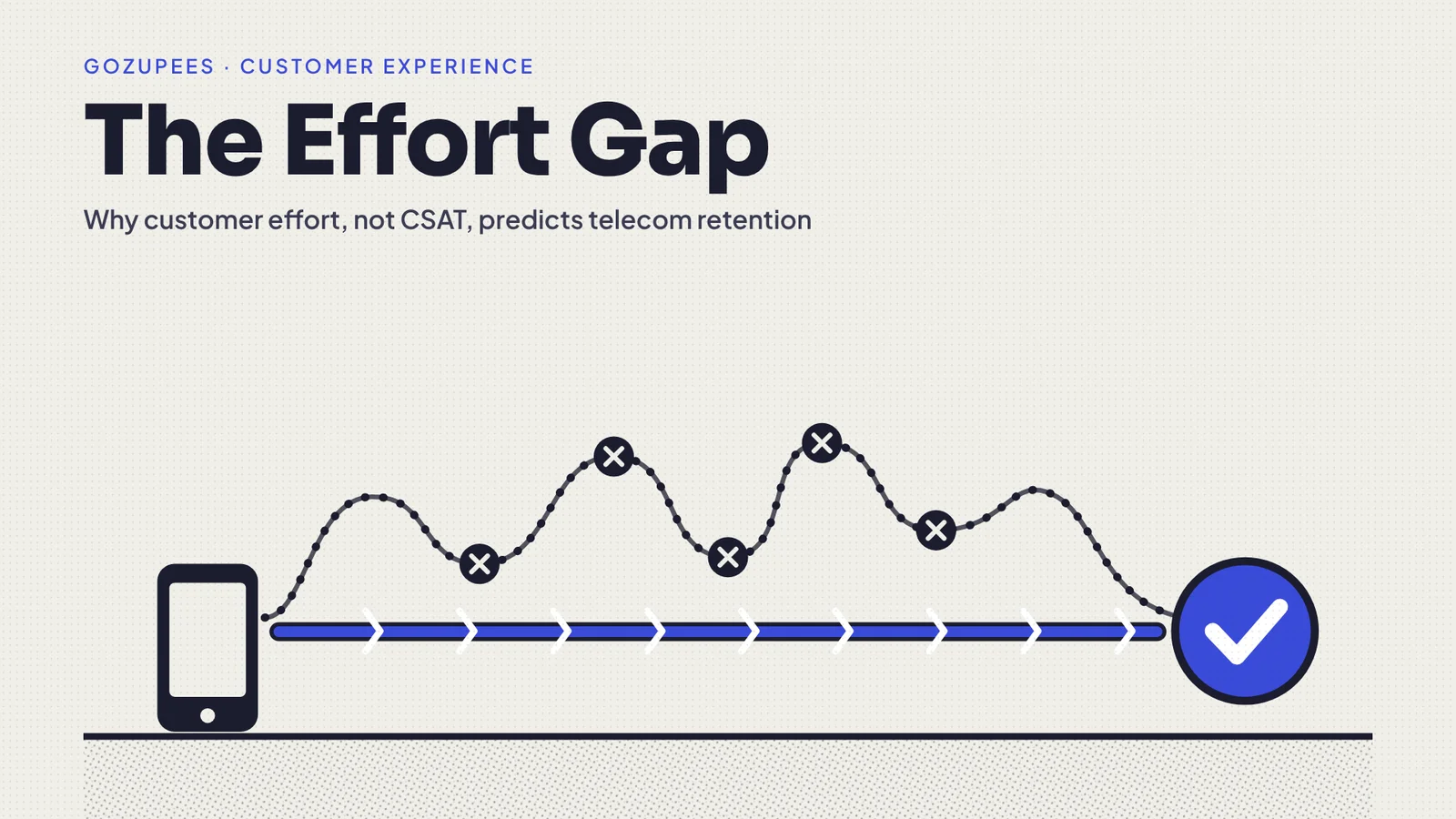
The Effort Gap: Why Customer Effort, Not CSAT, Predicts Telecom Retention
Satisfaction tells you how a customer felt when the call ended. Effort tells you whether they will still be your customer next year.
Satisfied customers still leave
Telecom, ISP and utility leaders track Customer Satisfaction (CSAT) because it is easy to collect. A 4 out of 5 on a closed ticket feels like proof that subscribers are loyal. The research says it is not.
In the Harvard Business Review study behind "Stop Trying to Delight Your Customers," which drew on more than 75,000 customers, 20% of satisfied customers still intended to leave and 28% of dissatisfied customers intended to stay (Dixon, Freeman and Toman, HBR, 2010). Gartner later reported that around 40% of customers will still leave even after a high-quality service experience.
This article makes one argument. The metric that separates subscribers who stay from those who leave is not how they felt at the end of the interaction. It is how much work it took to get there. The sections below cover where that work hides, how to design it out, and how to measure it.
What CSAT cannot see
CSAT is a post-contact score. It captures sentiment after a resolution, and it does not capture the effort spent reaching one. Picture a subscriber who spends 15 minutes inside rigid IVR menus, repeats account details to two agents and power-cycles a modem on instruction. The ticket closes, the agent is courteous, the survey comes back a 4. The subscriber still remembers an exhausting experience.
The evidence points the same way. In the HBR study, 94% of customers who reported low effort intended to repurchase and 88% planned to spend more. Among customers who struggled, 81% intended to share negative word of mouth. Going above and beyond made customers only marginally more loyal than simply meeting their needs.
Gartner frames the stakes the same way. Its research found that service interactions are "far more likely to lead to disloyalty than loyalty," and Gartner's Brent Adamson put it plainly: a great service experience can only mitigate disloyalty, not make customers more loyal.
The practical conclusion is that service teams should stop trying to impress customers and start removing the work they are asked to do. That shifts the job from improving agent behavior to redesigning the operation around the customer's effort.
Four layers of friction in telecom service
Effort accumulates whenever a customer does mental or operational work that the provider's systems could do instead. In high-volume telecom environments it builds up across four layers. The evidence is strongest for channel switching. The other layers reflect our view of how contact center design creates work for the customer.
- Identity verification friction. Asking customers to find account numbers, confirm PINs or repeat personal details on every transfer adds work before the real problem is even heard. Recognition should happen at the point of entry, using signals the provider already holds, such as the calling number, an authenticated app session or a device token.
- Diagnostic translation friction. Asking non-technical subscribers to read status lights, find a modem model number or check cabling turns them into the diagnostic tool. Line and hardware telemetry should be read directly from the network, not relayed through the customer's description.
- Channel-switching friction. When a chat widget sends someone to a phone line, or an emailed ticket needs a web form, the customer pays a task-switching penalty. The HBR study found that 57% of inbound calls came from customers who had gone to the website first.
- Context repetition friction. Re-explaining a fault to a second-tier specialist or on a new channel tells the customer the provider has forgotten them. Continuity means the full conversation history, including what was already tried, travels with the customer across every touchpoint.
Satisfaction-driven vs. effort-reduction operations
The two models differ in what they measure and in who does the work. The table contrasts them on five operating benchmarks.
| Benchmark | CSAT-driven reactive model | Effort-reduction model |
| Primary metric | Post-call CSAT and average handle time | Customer Effort Score (CES), repeat contact rate and zero-touch resolution |
| Verification | Customer confirms account details verbally | Silent recognition from authenticated signals the provider already holds |
| Diagnostics | Guided verbal troubleshooting scripts | Automated line checks and API queries before the customer explains |
| Handoff | Cold transfer, customer restates the issue | Context-synchronized handoff with full history attached |
| Retention signal | Positive scores can coexist with churn | Retention tracked against effort at each step of the journey |
Four pillars for an effortless operation
Removing effort takes more than a better chatbot. It takes an action layer connected to the systems that hold the answers. Each pillar below removes one layer of friction from the section above.
| Pillar | What it does | Friction it removes |
| 1. Silent account recognition | Maps the inbound number, digital session or device token to the CRM record at the start of the interaction, so no identity interrogation is needed | Identity verification |
| 2. Direct telemetry ingestion | Connects the conversation to operational support systems so modem signal, packet health and node status are checked before the customer is asked to describe the fault | Diagnostic translation |
| 3. Single-session execution | Gives the agent permission to complete the request in the same interaction, for example correcting an invoice address, applying a verified SLA credit or triggering a line re-authorization | Channel switching |
| 4. Predictive next-best-action | Anticipates the follow-up question and answers it first, for example sending a plain summary of how a plan change will appear on the next bill | Context repetition and repeat contacts |
Write access is what makes pillar 3 valuable, and it is also where governance matters most. Each action should run under scoped permissions, leave an audit trail and escalate to a person with the full context when it falls outside what the agent is allowed to do.
How to measure effort
Keep CSAT, but stop treating it as the headline. Pair it with measures that show the work behind a resolution:
- Customer Effort Score (CES). One question after the interaction, such as how easy it was to get the issue handled, tracked by intent and channel.
- Repeat contact rate. Share of customers who return about the same issue within a set window.
- Context-preserved handoff rate. Share of transfers where the receiving agent or channel already has the history.
- Zero-touch resolution rate. Share of requests completed in a single session with no manual back-office step.
Regulators track the same thing. Ofcom's complaints report found that satisfaction with complaint handling in 2024 was 61% for mobile, 58% for broadband and 60% for landline, up from just over 50% in 2022. In the same research, 23% of broadband customers and 14% of mobile customers had a reason to complain. When nearly one in four broadband customers has a reason to complain, the experience of resolving it becomes a retention issue, not a service-desk detail.
Why this is a margin strategy
Reducing effort is a service improvement, and it is also a cost and retention lever. Each avoided repeat contact removes a handled contact from the queue. Each first-contact resolution lowers the pressure on agents, which matters in an industry where turnover is a standing cost. And each subscriber who never has to struggle is one less customer weighing a competitor's offer at renewal.
The order of investment follows from this. Start with the friction layers that generate the most repeat contacts, prove the effect on repeat contact rate and CES, then extend write access to more request types as confidence and controls mature.
Where to start
GoZupees helps businesses make AI a multiplying force across their customer experience and operations. For telecom, ISP and utility teams, the first step is to look at the effort inside today's journeys: where customers verify, wait, switch channel or repeat themselves.
Not sure how your AI conversations are really performing? GoZupees works with teams to track quality, handoff and outcomes. If that is on your roadmap, book a demo at www.gozupees.com.