The Autonomous Contact Center: Architectural and Economic Foundations of Zero-Contact Operations
Reactive support has a cost ceiling that better tooling alone does not lift, because its cost rises with customer friction, not with how well that friction is handled.
For leaders in high-volume telecommunications, broadband and digital subscription businesses, the cost structure of customer operations has reached an efficiency ceiling. Historically, investment in customer experience went into making reactive interactions cheaper. First-contact resolution (FCR), average handle time (AHT) compression and queue containment all aim to reduce the variable cost of each contact.
But reactive models share a structural flaw, whether they run on human agents, copilot-assisted representatives or conversational AI: variable cost scales with customer friction. By the time a subscriber contacts support, the friction has already happened. Service latency, unannounced maintenance, a billing discrepancy or a provisioning delay has already damaged the relationship.
The alternative is what we call Zero-Contact Architecture (ZCA): using automated systems, telemetry orchestration and predictive business logic to resolve service disruptions before the customer has to get in touch. The benchmark moves from resolving inquiries quickly to not needing the inquiry at all.
From labor efficiency to capital efficiency
In subscription businesses, customer support is typically one of the largest variable cost centers, and a zero-contact model changes its unit economics by shifting work from labor to software infrastructure.
The linear labor constraint. In a reactive model, growing the subscriber base means growing support capacity, whether that is headcount, software seats or per-turn processing fees. Once telemetry ingestion and remediation logic are deployed, the cost of resolving each additional anomaly or account state change falls sharply. It does not reach zero. Build, integration, monitoring and exception handling remain, but the cost no longer rises in step with every extra contact.
The churn argument. Customer churn is rarely caused by one catastrophic event. It often builds through small, recurring frictions: brief network drops, line resets nobody confirmed, or ambiguous billing line items. Fixing those frictions at the source, before the customer notices, targets the pattern that tends to precede defection. We would treat the size of that effect as something to measure in your own base, not assume.
The four architectural layers
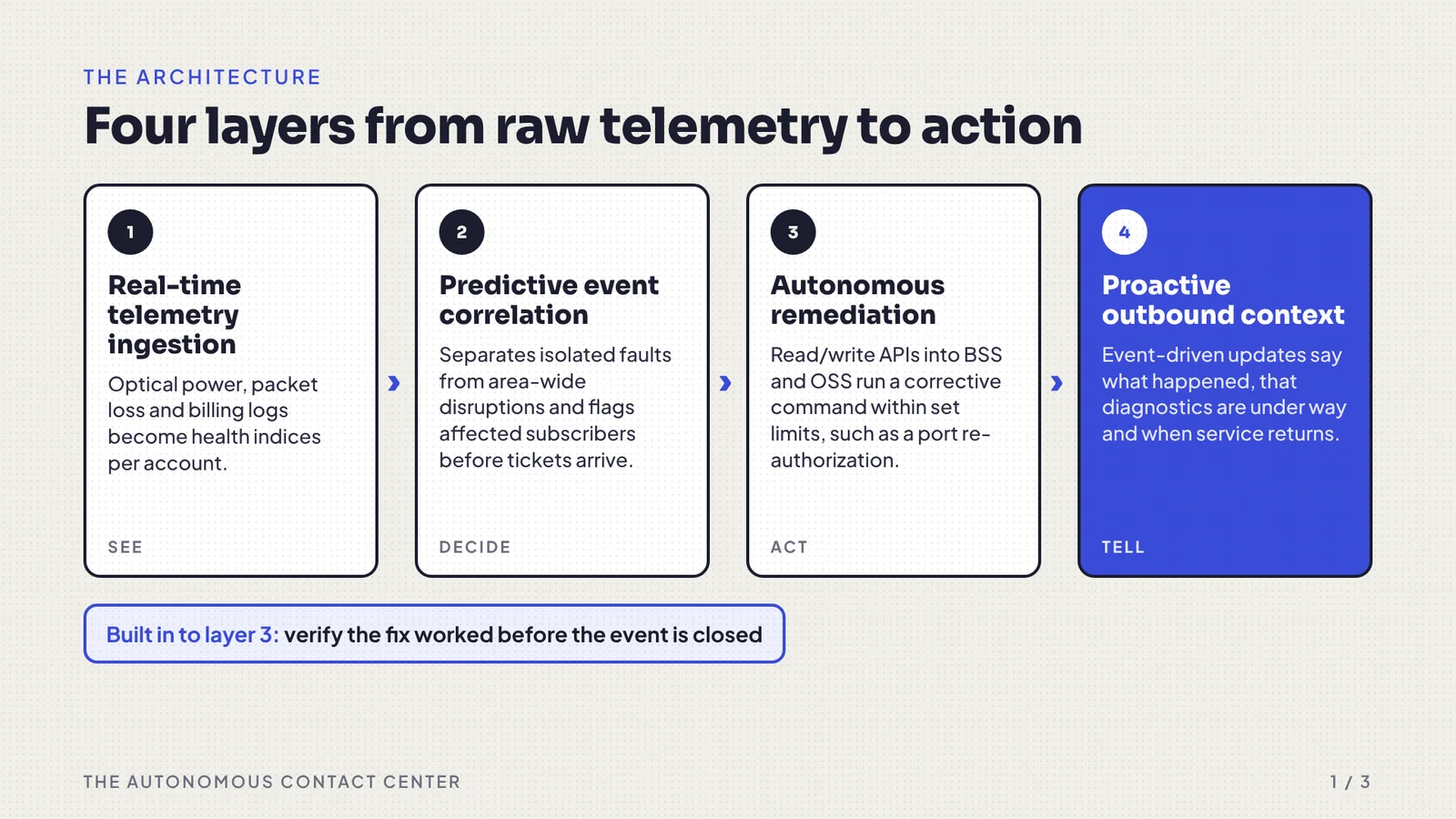
A working zero-contact environment links infrastructure telemetry directly to customer account states through four connected layers.
- Real-time telemetry ingestion. Telecom and ISP networks generate continuous data: optical power levels, modem signal-to-noise ratios, packet loss ratios and billing system event logs. This layer converts those raw streams into structured health indices tied to each customer account identifier.
- Predictive event correlation. Raw telemetry has to be processed to be useful. This layer separates isolated hardware faults from systemic disruptions in an area. When packet degradation crosses a threshold across an optical node, it flags the affected subscriber cluster before customers report tickets.
- Autonomous remediation. A diagnosis without an action leaves the friction in place. This layer uses secure read/write APIs into business and operational support systems (BSS and OSS). When it detects a line synchronization error or a billing format mismatch, it runs a corrective command, such as a remote port re-authorization or an automated invoice adjustment, within pre-set limits. It then checks that the fix worked before closing the event. An action that is never verified is a failure waiting to be found by the customer.
- Proactive outbound context. When a fix needs a field visit or the outage is widespread, the system moves from silent resolution to communication. Instead of absorbing a wave of inbound calls, it sends context-rich, event-driven updates through the customer's preferred channel. The message says what happened, confirms that diagnostics are under way and gives a restoration estimate.
Reactive FCR vs. zero-contact resolution
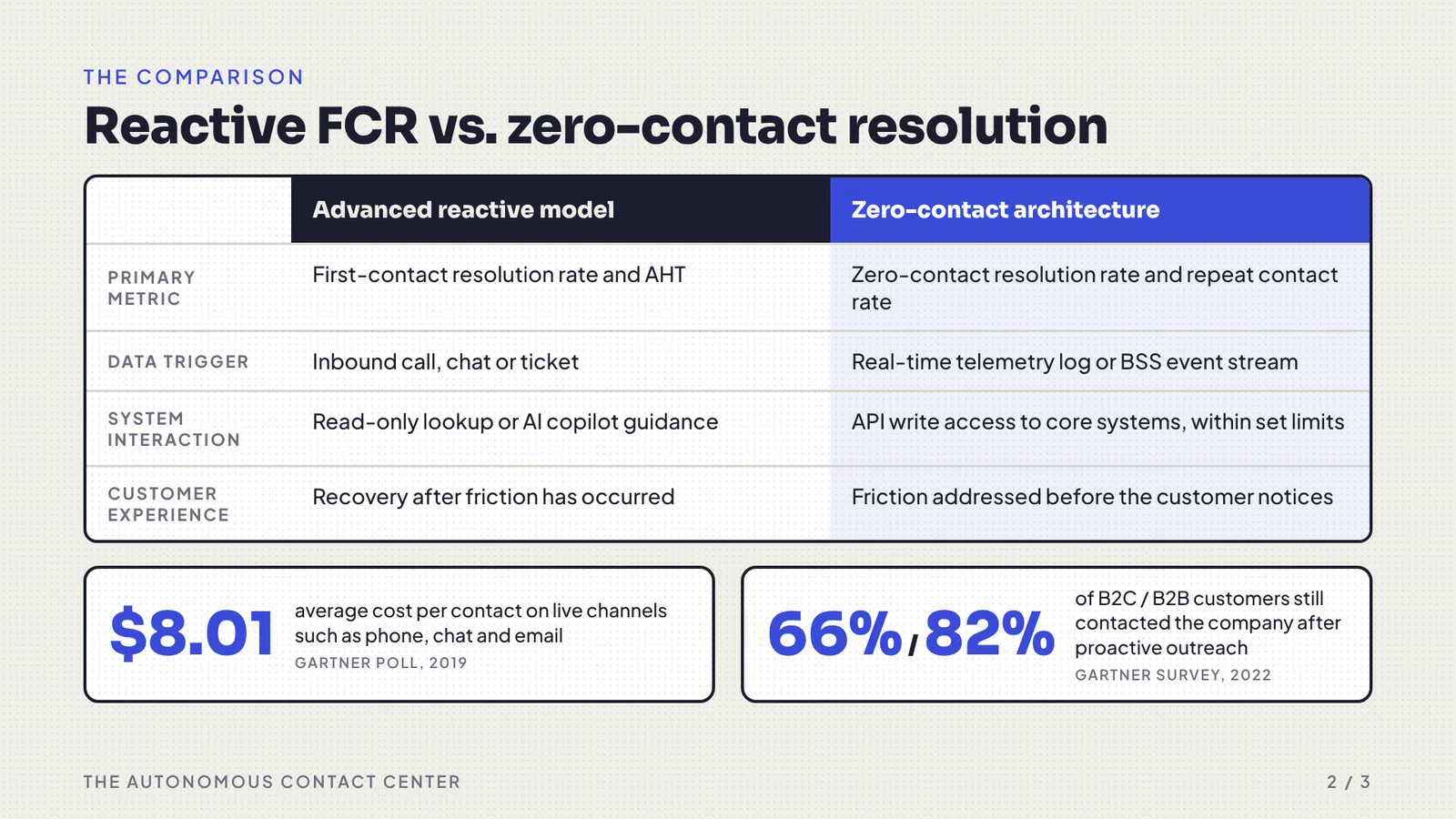
The table compares a high-performing reactive operation with a zero-contact model. It describes design intent, so measure each row in your own operation before you quote it.
| Benchmark | Advanced reactive model (FCR) | Zero-contact architecture (ZCR) | What changes |
| Primary metric | First-contact resolution rate and AHT | Zero-contact resolution rate and repeat contact rate | Focus moves from handling contacts to preventing them |
| Data trigger | Inbound call, chat or ticket | Real-time telemetry log or BSS event stream | Less reliance on customers reporting the problem |
| System interaction | Read-only agent lookup or AI copilot guidance | API write access to core systems, within set limits | Fewer manual steps and input errors, with guardrails |
| Cost per contact (reference) | Live channels averaged $8.01 per contact in Gartner's 2019 poll | No contact occurs for the fault. Cost moves to platform, integration and monitoring | Cost shifts from per contact to fixed. It does not disappear |
| Customer experience | Recovery after friction has occurred | Friction addressed before the customer notices | Aims to lower complaints. Track in your own CSAT and NPS |
| Operations capacity | Inbound spikes during network disruptions | Smaller, more predictable spikes | Not eliminated: 66% of B2C and 82% of B2B customers in a Gartner survey contacted the company after proactive outreach |
The last row matters most. In that survey, Gartner found many customers reached out to ask for more detail or to check a message was genuine. Proactive messages that leave questions unanswered can generate contacts instead of preventing them. A zero-contact design has to make the message complete: what happened, what is being done and when it will be fixed.
A phased roadmap for deployment
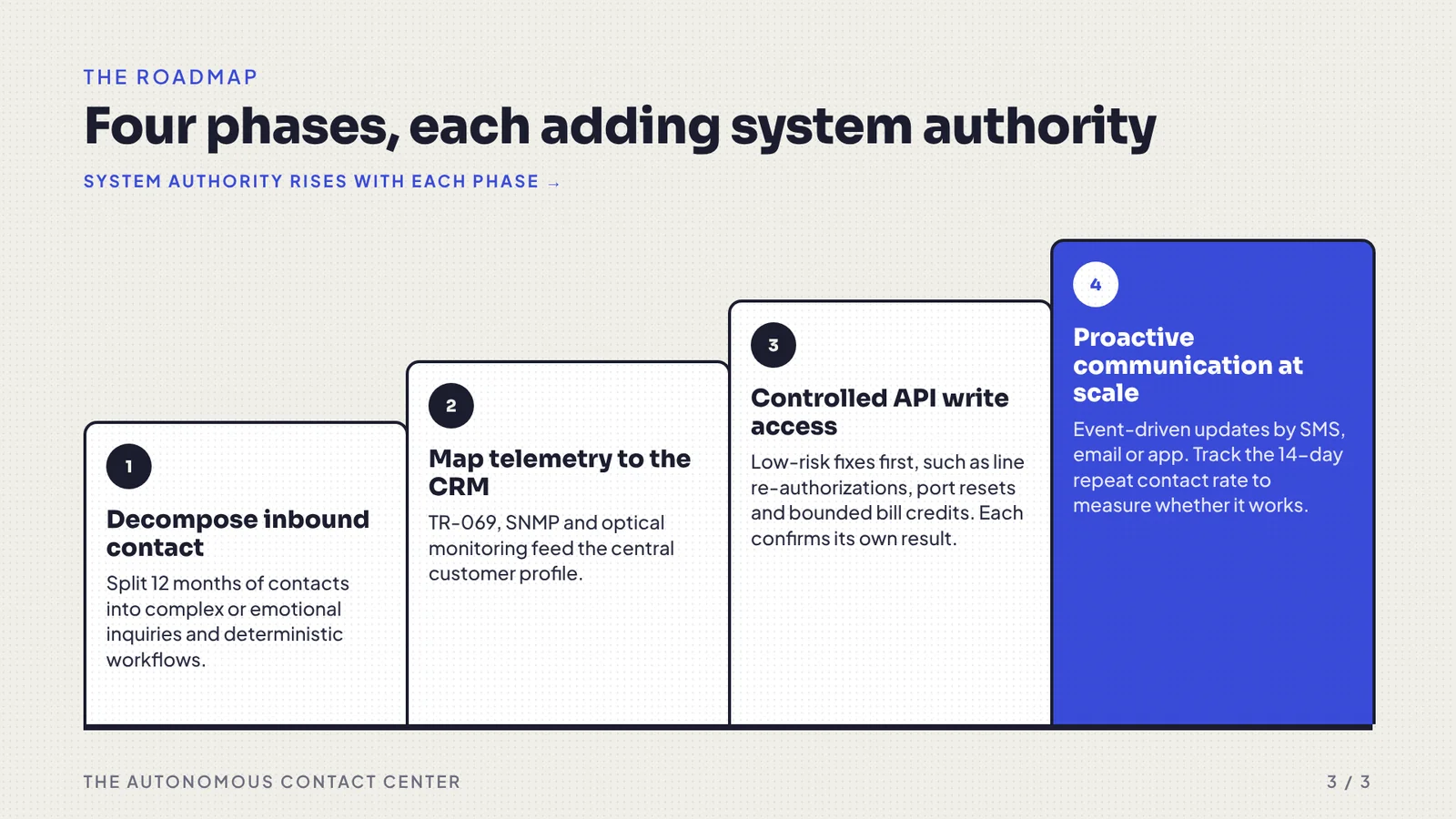
Move to a zero-contact model in four phases, so that each step adds system authority only after the one before it has proven stable.
- Decompose inbound contact. Audit all inbound contact drivers from the past 12 months and split them in two. Complex or emotional inquiries, such as cancellations, custom contract negotiations and complex billing disputes, stay with augmented human teams. Deterministic operational workflows, such as line health checks, service status queries, payment acknowledgments and outage updates, are the targets for automation.
- Map network telemetry to the CRM. Unify the data silos. Build continuous pipelines from network management telemetry (TR-069, SNMP, optical monitoring) into the central customer profile, so network tools and customer service workspaces read the same real-time account data.
- Deploy API write access in controlled steps. Give automated engines read/write permissions in high-volume, low-risk categories first: line re-authorizations, port resets and system-generated bill credits bounded by strict financial validation rules. Require each action to confirm its own result before it is logged as resolved.
- Scale proactive, context-aware communication. Deploy event-driven outbound workflows that send personalized updates by SMS, email or app notification before affected subscribers get in touch. Track the 14-day repeat contact rate to see whether the outreach is working.
The future of enterprise operations
In high-volume subscription industries, efficiency and long-term retention depend on removing operational friction. Measuring contact center success only through reactive handling metrics keeps an enterprise tied to rising labor costs and to recovering after the damage is done.
Zero-contact architecture offers another path. By linking network telemetry to automated execution and to proactive communication, operations leaders can remove customer friction at the source, protect margin and rethink how customer operations work.
Not sure how your AI conversations are really performing? GoZupees works with teams to track quality, handoff and outcomes. If that is on your roadmap, book a demo at www.gozupees.com.