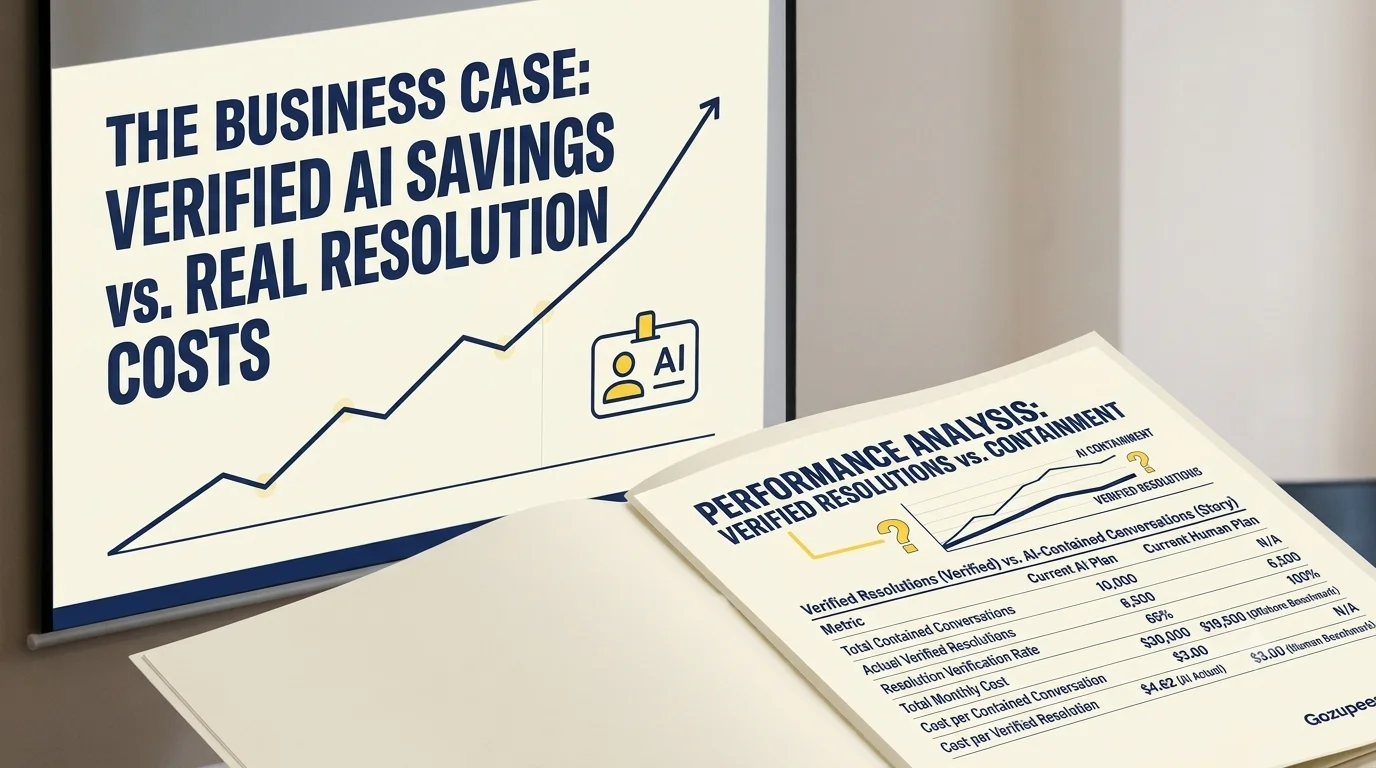
The business case for AI in customer service usually rests on one claim: that automation lowers the cost of service. Whether that claim holds depends on the first question finance asks, which is which line on the invoice changes.
Time saved is the usual starting point: an agent that handles part of a task releases capacity.
Finance counts that capacity as a saving only when a budget line moves, through fewer seats, licenses or outsourced hours, or through hiring avoided. If the invoice is unchanged after the project, the saving exists on a slide and nowhere else.
The research points the same way. In Gartner's July 2026 survey, service and support leaders put a median 12% of their 2025 budget into AI, the highest of the ten functions assessed. Only 24% of them demonstrated positive financial returns across their AI use cases.
The question is not whether AI can save time. It is whether that saving ever shows up on a line finance can see.
In brief
• Spending is ahead of proof. Service and support leaders put a median 12% of their 2025 budget into AI, the most of ten functions Gartner assessed, yet only 24% demonstrated positive financial returns across their AI use cases.
• Full automation may not get cheaper. Gartner forecasts GenAI cost per resolution above $3 by 2030, higher than many B2C offshore human agents, and expects full automation to be too costly for most organizations.
• Humans stay in the model. 87% of customers say an option to reach a human is essential, and Gartner advises against making GenAI a mandatory first step.
• A case holds up under three conditions. A named cost line changes, cost is measured per resolved issue, and the human path is budgeted honestly.
What Gartner actually forecast
On January 26, 2026, Gartner published three predictions for customer service:
• By 2030, GenAI cost per resolution will pass $3, above what many B2C offshore human agents cost.
• By 2028, AI-related regulation will lift assisted service volume by 30%.
• By 2030, one in ten Fortune 500 firms will double customer service spending to use AI for hyperpersonalized, proactive experiences.
Gartner points to three drivers of rising cost: higher data center costs, AI vendors moving from subsidized growth toward profitability, and use cases that grow more complex, consuming more tokens and requiring costlier talent.
Patrick Quinlan, Senior Director Analyst at Gartner, said service leaders are determined to cut costs with AI, but that returns are far from guaranteed. His verdict on the extreme case: "Full automation will be prohibitively expensive for most organizations."
Gartner expects most organizations to abandon automation as a cost-cutting strategy. The leaders, it says, will use AI to build customer lifetime value, repurchase rate and brand loyalty instead. Quinlan also expects organizations to need to keep, or even rehire, human agents.
How to read the forecast
1. It is a forecast, and the release does not show its method. The $3 figure is presented as a prediction. The release gives no methodology or sample size and refers readers to a separate Gartner report, Predicts 2026: Generative AI Will Cost a Lot More Than You Think.
2. The warning is about full automation. Gartner's advice for most organizations is to stop treating automation as a cost-cutting strategy, not to stop using AI.
3. The forecast is contested. A Call Centre Helper article from February 17, 2026 reflects the view of CX services firm Sabio that misaligned incentives, more than the technology, drive poor ROI, and argues for outcome-based pricing. Sabio sells that model, so read it as a position, not a finding.
Spending is ahead of proof
Gartner's July 8, 2026 release adds survey evidence. In a survey of 1,303 senior leaders across industries, fielded January to April 2026, service and support leaders had invested a median of 12% of their 2025 budget in AI, the highest of the ten business functions assessed.
Returns lagged the investment. Only 24% of service and support leaders demonstrated positive financial returns across their AI use cases.
That figure counts leaders, not individual use cases, and the release does not report what share of use cases paid back. It does not say AI fails. It says the evidence of financial payback is thinner than the size of the investment.
Time saved is not a budget line
AI business cases typically start from productivity: an agent that handles part of a task releases capacity. Finance classifies that benefit as non-cashable. It becomes cashable only when it reduces a cost that would otherwise have been incurred.
Customer service costs are largely fixed in the short run. Salaries, seat licenses and outsourcing contracts do not fall with workload. They fall in steps, when headcount is reduced, a contract is renegotiated or a planned hire is avoided. A productivity gain spread thinly across a team does not change the invoice until one of those steps is taken.
A testable case therefore names the mechanism: a smaller team through attrition or redeployment, a lower license count, fewer outsourced hours, reduced overtime, or hiring avoided against a forecast rise in volume.
Where no cost line moves, the benefit should be reported as capacity: absorbing volume growth, faster response times or higher quality. These are legitimate gains, but they belong in the value case, not in the cost-saving line.
Count per resolved issue, not per conversation
The choice of unit changes the answer. Consider an illustrative scenario with hypothetical figures.
Total monthly AI spend is $30,000. The AI contains 10,000 conversations, and a sample review finds that only 6,500 were truly resolved. The rest were abandoned, repeated or sent back.
| Measure | Per contained conversation | Per resolved issue |
| Monthly AI spend | $30,000 | $30,000 |
| Units counted | 10,000 | 6,500 |
| Cost per unit | $3.00 | about $4.62 |
Per contained conversation, the cost sits at the $3 mark Gartner forecasts for 2030. Per resolved issue, it is about $4.62, and that is what the business actually bought.
The same logic applies to any pricing model. Whether a contract charges by seat, conversation, minute, token or outcome, the figure to carry into the business case is total cost divided by verified resolutions, including everything that happens after the AI hands off.
The human path is a budget line
In an August 4, 2026 release based on a survey of 3,566 B2B and B2C customers, Gartner reported that 87% say it is essential to have an option to reach a human agent when a company uses GenAI. Its guidance to service leaders is not to make GenAI a mandatory first step for every issue. Customers pushed through several unsuccessful AI interactions before reaching a person are less likely to use the tool again.
Regulation points the same way. Gartner forecasts that rules guaranteeing access to a human will lift assisted service volume by 30% by 2028, and expects organizations to need to keep or rehire human agents. A plan that assumes human cost falls to zero runs against Gartner's own research.
The staffing assumption deserves its own line in the model, expressed as a range rather than a single number.
What to put in a business case
A business case that survives review addresses each element below.
| Element | What to show |
| The cost line that changes | Which budget line shrinks, by how much, and when |
| Unit cost | Total cost divided by verified resolutions, not contained conversations |
| Total cost | Platform, usage, integration, supervision, testing and the human fallback |
| Price risk | A scenario where unit prices rise, given Gartner's forecast of vendors moving to profitability |
| Quality guardrails | Repeat contact, escalation access and customer satisfaction, measured alongside cost |
| Human capacity | Staffing assumptions for the people customers will still ask for |
| Benefits beyond cost | Retention, repurchase or revenue effects, reported separately and labeled as estimates |
| Review date | When the case is checked against actuals |
Questions to ask internally
• Which budget line will be lower a year from now because of this project, and by how much?
• What is our current cost per verified resolution, and how do we measure verification?
• If unit prices rose by half, would the case still hold?
• What share of customers will still ask for a person, and is that staffed?
• Which of our AI use cases would we say has a positive financial return today, and on what evidence?
Six decisions for the next quarter
1. Choose the unit. Agree that cost per verified resolution is the headline cost metric.
2. Name the line. For each AI project, write down the cost line expected to change.
3. Sample for resolution. Review a regular sample of conversations to estimate how many were truly resolved.
4. Stress-test price. Add a rising-price scenario to every multi-year case.
5. Budget the human path. Put a range for human staffing in the model.
6. Separate cost from value. Report cost savings and growth benefits apart, so neither hides the other.
See it working
Not sure how your AI conversations are really performing? GoZupees works with teams to track quality, handoff and outcomes. If that is on your roadmap, book a demo at www.gozupees.com.